
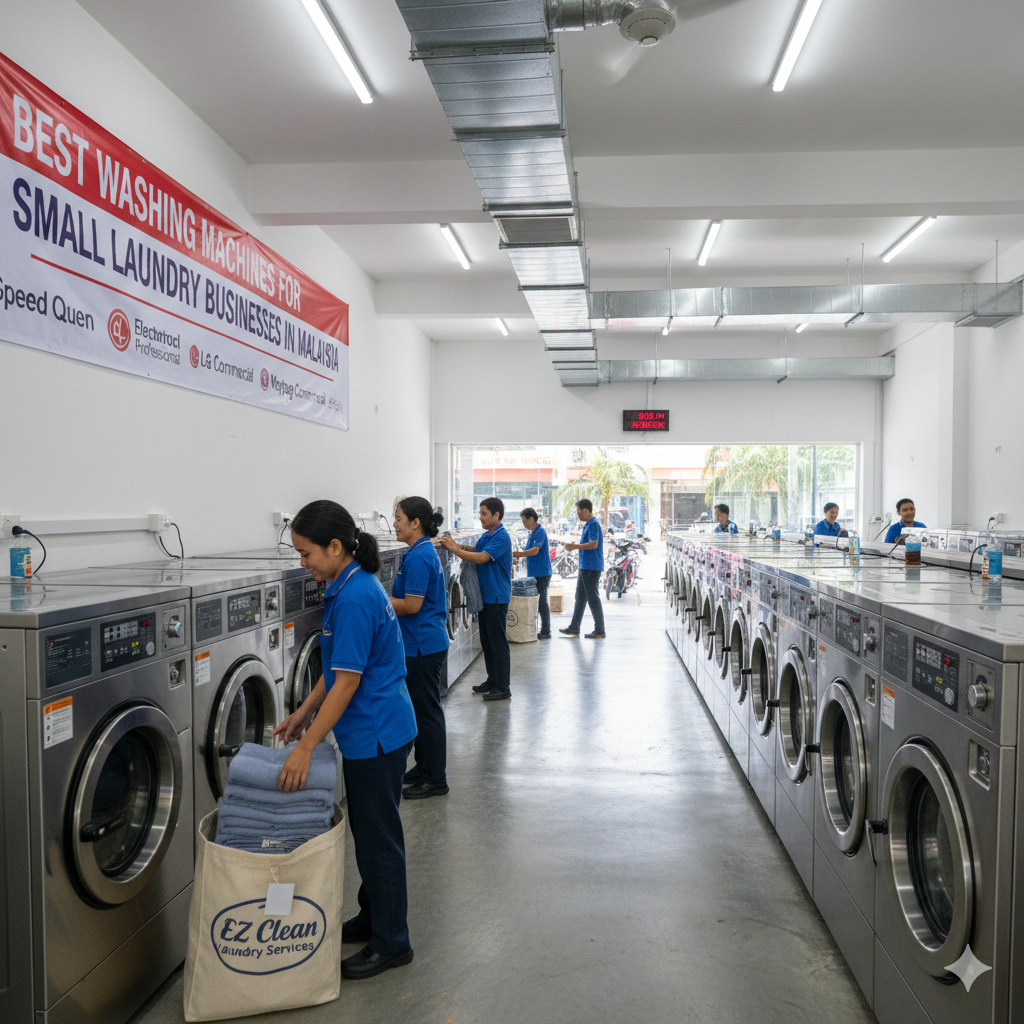
For small laundry businesses in Malaysia, every decision impacts profitability, customer satisfaction, and long-term sustainability. Among the most critical choices is the selection of your washing machines. Far from being mere appliances, these machines are the workhorses of your operation, directly influencing efficiency, utility costs, and the quality of service you deliver. As an SEO content writer for Atos, we understand the nuances of the commercial laundry sector and are here to guide you through making an informed decision.
This article delves into the key considerations and top recommendations for best washing machine for small laundry business in Malaysia, supported by industry insights and practical advice.
The Malaysian Laundry Landscape: A Growing Opportunity
The laundry service market in Malaysia is experiencing steady growth, driven by increasing urbanization, busy lifestyles, and the rising demand for convenient and professional garment care. According to Statista, the revenue in the “Laundry Care” segment in Malaysia is projected to reach US$132.3 million in 2024, with an annual growth rate (CAGR 2024-2028) of 4.13%. This indicates a robust market with significant potential for small businesses. However, to capitalize on this growth, operational efficiency and cost-effectiveness are paramount.
Understanding Your Needs: Key Factors for Small Businesses
Before diving into specific models, it’s crucial to assess your business’s unique requirements. Ignoring these factors can lead to costly mistakes and suboptimal performance.
1. Capacity and Throughput: Matching Volume to Machine
For a small laundry business, finding the right balance between machine capacity and your daily expected load is vital. Over-specifying can lead to wasted energy and underutilized assets, while under-specifying can create bottlenecks and customer dissatisfaction.
Average Load Size: What is the typical weight of laundry your customers bring in?
Daily Volume: How many loads do you anticipate processing per day?
Peak Hours: Do you experience significant surges in demand?
Table 1: Capacity Guidelines for Small Laundry Businesses
| Business Size | Daily Loads (Estimate) | Recommended Washer Capacity (kg) | Example Machine Type |
|---|---|---|---|
| Micro (Home-based) | 5-10 | 10-15 | Heavy-duty domestic/Light commercial |
| Small (Shopfront) | 15-30 | 15-25 | Commercial front-loader |
| Growing Small (Multiple units) | 30-50+ | 20-30+ | Industrial front-loader |
Note: These are general guidelines; actual needs may vary.
2. Energy and Water Efficiency: Impact on Operating Costs
In Malaysia, electricity and water costs are significant operational expenses. Choosing energy and water-efficient machines can lead to substantial savings over the machine’s lifespan.
Energy Consumption: Look for machines with high energy efficiency ratings. Inverter motors, for example, consume less electricity by adjusting power based on the load.
Water Usage: High-efficiency commercial washers often use significantly less water per cycle compared to older models. This not only reduces water bills but also lowers associated heating costs if you use hot water.
Fact: A study by the U.S. Environmental Protection Agency (EPA) found that commercial washing machines can account for up to 20% of a laundry business’s total water consumption. Investing in high-efficiency models can reduce water usage by 30-50%.
3. Durability and Longevity: A Long-Term Investment
Commercial laundry environments are demanding. Machines operate continuously, handling diverse fabrics and heavy loads. Durability is non-negotiable.
Construction Materials: Stainless steel drums and heavy-duty components are indicators of robust construction.
Motor Type: Industrial-grade motors are designed for continuous operation and have a longer lifespan.
Warranty: A comprehensive warranty from a reputable supplier like Atos signifies confidence in the product’s durability.
4. Features and Functionality: Enhancing Service Quality
Modern commercial washing machines offer a range of features that can enhance your service and efficiency.
Multiple Wash Programs: Pre-set programs for different fabric types (e.g., delicates, heavy-duty, whites) ensure optimal cleaning and fabric care.
High Spin Speed: Faster spin speeds extract more water, reducing drying time and energy consumption for dryers.
Programmable Controls: Allows for custom wash cycles, crucial for specialized services.
Coin/Card Operated Systems: Essential for self-service laundromats, offering convenience and automated payment.
5. Ease of Maintenance and Serviceability: Minimizing Downtime
Downtime due to machine breakdowns translates directly to lost revenue.
Accessibility: Machines designed for easy access to components facilitate quicker repairs.
Parts Availability: Ensure spare parts are readily available in Malaysia. Atos, with its established presence, ensures reliable access to parts and skilled technicians.
Technical Support: A strong local service network is invaluable for prompt and effective maintenance.
Top Washing Machine Types for Small Laundry Businesses
Considering the above factors, here are the primary types of washing machines suitable for small laundry businesses in Malaysia:
1. Commercial Front-Load Washers (The Workhorse)
Pros: Highly efficient (water and energy), excellent cleaning performance, good capacity range (15kg to 30kg+), durable, high spin speeds.
Cons: Higher initial investment than top-loaders, can be heavier and require robust installation.
Ideal For: Most small to medium-sized laundry shops, self-service laundromats, and businesses prioritizing efficiency and quality.
Graphic 1: Illustrative Diagram of a Commercial Front-Load Washer (Typical Design)
(Imagine a clean, professional line drawing or photograph of a commercial front-load washer, highlighting its robust construction, large door, and control panel. Perhaps an arrow pointing to “High Spin Speed” or “Programmable Controls”).
2. Industrial-Grade Top-Load Washers (For Specific Niche)
Pros: Generally lower initial cost than front-loaders, simpler operation, can be more tolerant of unbalanced loads.
Cons: Less water and energy-efficient than front-loaders, lower spin speeds (longer drying times), can be harder on fabrics due to agitator action.
Ideal For: Very small, budget-conscious operations with lower daily volumes, or specific applications where simplicity outweighs efficiency concerns.
3. Stackable Washer-Dryer Units (Space Savers)
Pros: Excellent for maximizing space in smaller premises, often available in commercial-grade versions.
Cons: Limited capacity compared to separate units, if one unit breaks, the entire stack might be out of commission.
Ideal For: Businesses with limited floor space, or those offering combined wash-and-dry services in a compact footprint.
Atos: Your Partner in Laundry Excellence
At Atos, we understand the critical role that reliable and efficient equipment plays in the success of your small laundry business. We offer a curated selection of commercial washing machines designed to meet the rigorous demands of the Malaysian market. Our machines are chosen for their:
Proven Durability: Built to withstand continuous commercial use.
Exceptional Efficiency: Helping you keep operating costs down with advanced water and energy-saving technologies.
Superior Performance: Delivering consistent, high-quality cleaning results that keep your customers coming back.
Comprehensive Support: Backed by Atos’s dedicated customer service and technical support network across Malaysia, ensuring minimal downtime and maximum productivity.
Choosing the best washing machine for small laundry business is a strategic decision that impacts your profitability and reputation. By carefully evaluating your needs against the factors outlined above and partnering with a trusted supplier like Atos, you can equip your business for long-term success in Malaysia’s vibrant laundry market.
Download and contact Atos today for a personalized consultation and let us help you find the perfect washing machine solution for your business.



 繁體中文
繁體中文  English
  Bahasa Melayu
  தமிழ்
தமிழ்